The Least and Most Coding of My Life
I’ve been thinking of quitting. Not podcasting. Sleeping.
The past six months have been… I don’t know. I’ve been doing the least amount of coding I’ve ever done in my career as a developer. But also the most. The most lines of code written for sure, by a huge metric. But also the least.
And I think I’ve already quit recreational reading. To a certain extent. That can’t be good, can it? I like to read.
So today’s not a normal episode. There’s no interview, there’s no hour-long story. This is some field notes, a shorter, rougher, a little bit more personal trying to capture a moment in time. Regular episode is on its way but I’ve got something I want to share while it’s fresh.
And the thing I can’t shake is this question: in a moment where expertise has a half-life of months and shrinking all the time, what does it mean to learn something? To invest in learning when everything’s churning? How do you know if you’re building skills or just spinning?
Let me show you what I mean.
Multiple Agents, Multiple Dings, Zero Peace
Right now I’m in my office. I’m sitting at my standing desk. I have my mic in front of me, my multiple VS Code windows open, and the way I tend to work is my VS Code window is kind of split in two with the IDE stuff on the one side and on the other side is a terminal with Claude Code.
And actually usually more than one. Right now I see two. Now I have another VS Code open for agent core demo, then another one for AWS Houston meetup.
And it feels incredible. I’m thinking at whiteboard speed. Just describing things and producing code. Describing features. Describing edge cases. Describing what I want the end state to be. And the system is working to make it real.
But it’s also chaos. I have many sessions running, and I’ll hear them stop because I put stop hooks in.
So I’ll hear momentum agent stopping and that means the momentum agent that was working on my AI running thing, fixing the problem where it’s handling dates wrong, needs some input for me. And then while I’m figuring that out I might hear Azure workshop agent stopping and I’ll go over and see what’s going on there.
It feels like I’m getting so much done. But it also feels stressful, like I’m not keeping up. Like I Love Lucy with the chocolates on the conveyor belt.
So in a way it feels like productivity. Like I finally got an intern. A very fast intern that runs 24/7.
But then there was this moment, this tiny kind of stupid moment I had that made me suspicious.
It Should Be Running
It was the shower. I had this thought, you know, before I jump in the shower I might as well get Claude Code working on this next ticket. And I remember thinking like, well that’s kind of a weird sentence, isn’t it?
Because it wasn’t like, oh I really want to solve this specific problem or add this feature. It was like it should be running. Like I feel like it should be running, it should be doing something. It’s my intern, it has a fixed cost, and I just want to keep it going.
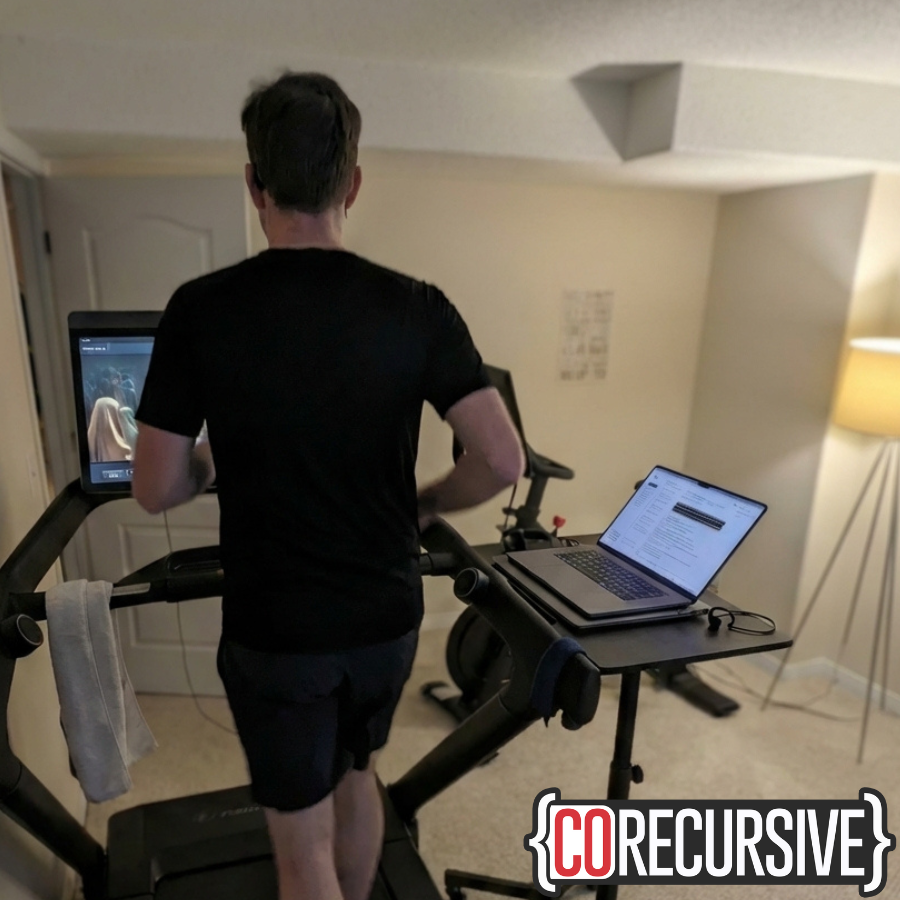
I bought this stand to put next to my treadmill so that while I’m doing a run I could have Claude Code running there.
But it felt so productive that I found myself reorganizing my life around keeping the machine spinning.
And to be clear, it’s fun. It’s exciting. I’m having fun. But my wife thinks I’m stressed out. And I am. But I’m also exhilarated, and I’m fixated on a bunch of different things. I’m tied to my laptop.
It reminded me of something that I haven’t thought about in years.
The Clicker Game That Explains Everything
Did you ever play Universal Paperclips? The title sounds like this scary AI doom scenario. AGI takes over the world and turns everything to paper clips. That’s the premise, but the actual experience of the game is way simpler.
It’s compulsive. It’s a clicker game. You have to keep clicking. You start by literally clicking a button to make paper clips, and then you buy an upgrade that makes clicking faster, and then you automate the clicking, and then you start optimizing the systems that optimize the systems.
And the lesson I learned wasn’t about the AI apocalypse. The lesson I learned was about addictiveness. The addictiveness of seeing the number go up. Of productivity happening. The thing is running and you need to watch it, and then you need to do more stuff, and then you need to build stuff that lets you do more stuff, and you’re making more and more progress and you can’t look away.
And this is where I’ve been lately. I think it’s been so much fun, but sometimes I’m not clear on the value. Claude Code has become my universal paperclip clicker.
That’s the paradox I feel. Because on the one hand, in this frothy time is when you can leave your dent in the world. You know, I had the Evan You interview where he created Vue. You know, it was in that churning period of JavaScript frameworks. That’s where there’s opportunity. People build amazing careers by stepping to the front in these high turnover moments and creating something unique.
And the other hand, it’s also a moment where it feels like there’s the least to be learned. Everything you learn will quickly change. Everything that’s hottest today will soon be gone. Not that AI coding agents are going away, but they’re changing so fast that it’s not possible to keep up. It’s not possible to learn persistent skills. The things you learn now won’t be useful in six months.
You can see this with all the little techniques that appear and then expire, like Ralph Wiggum loop. The Ralph Wiggum loop is basically you run Claude Code in a while loop and give it as a prompt this big file that it can edit with a clear end condition, and it can add in tasks or complete tasks.
And so instead of that ding where I need to prompt it to the next thing, its whole memory is wiped out and it starts a new session and it starts on the next to-do item.
It’s super useful right now, but better orchestration will make it irrelevant. It doesn’t make any sense that something like that should be needed, but it very much is and gives you a lot more power. But that’s the vibe, right? You’ll learn a trick and the existence of the trick is proof that it’s temporary and will go away.
That’s the paradox. You can sprint to the frontier now because there’s no experts, everything is being figured out, so you could make a difference, you could matter. But also you could wait because everything you learn today will be churned, will be gone tomorrow. You can catch up in several months just as easily as you can catch up right now. Both are true at the same time.
And there’s a cost to staying at the front, right? You have to keep up with everybody. And I started noticing the costs showing up in my home life.
The Big Rich Is Sitting There Unread
My wife and I have this pair book reading club where each of us has got a copy of a book and we read it and it’s fun. And the book we’re supposed to be reading right now is The Big Rich: The Rise and Fall of the Greatest Texas Oilman Fortunes. And I haven’t been reading it.
And it’s cold and it’s wintry here in Canada and there are these evenings where we’ll sit around by the fireplace and we’ll read, except I won’t be reading, right? I’ll have my laptop or we’ll be watching a show and I’ll feel the need to see if the migration’s done or if the agent’s stuck or if I can give it one more nudge, because this 24/7 intern is hard to keep going.
And so it seems like I’m always worried about something, like I’m super busy and that I’m not all the way present because I’m excited and stressed at the same time. But I think it’s not a tech problem, it’s an attention problem. It’s about when is this real work and when is this the paper clip clicker?
Because here’s the distinction I’ve been noticing.
There are good Claude sessions where I get a lot done. But there are bad ones, right, where I’m just chasing motion. When I have a moment before a meeting and so I say to Claude like, hey why don’t you start going through and fixing all the compiler warnings? Because it can chew through them and it’s better not to have the warnings.
Except you know it can’t fix all of them, and it ends up breaking something, and then it has a question. And then after the meeting I need to poke it some more, and now I’m busy wasting my attention on some unimportant task because I just want to make forward progress.
So that’s my takeaway. If you don’t know what done is, you’re not really delegating work, you’re just feeding the clicker. Just because I can build something now that I couldn’t before doesn’t mean I should.
Both Are True at the Same Time
So yes, things are changing. The tools are getting better. The interfaces for me are shifting from typing to talking often, you know, from physically writing the code to discussing the outcomes and the trade-offs and figuring out end states we can verify.
And my calendar is proof of that change. I’m speaking at a bunch of things this year and they’re all AI based. I’m going to be at SCALE in Pasadena giving a talk about my AI running coach. I’m going to be at MLCon talking about agents. Also, you know, teaching workshops, making videos for work, helping with Pulumi’s own coding agent Neo, infrastructure coding agent. That’s pretty cool.
This froth of AI agentic coding has consumed me, but that’s not required. You can sprint to the frontier and live there, try to keep up, maybe leave your dent in the world but probably not. Or you can just wait for things to stabilize, like the front end after, you know, React became dominant. And you won’t miss your chance to build useful things. Everything is moving so fast that it’s actually easier than ever to catch up later. Both are true at the same time.
So the investment is learning how to aim. Choosing that end state. Deciding what matters. Deciding what you’re going to do with your life, with your time. And being willing to step away even when that machine could be spinning.
So that’s my update. This is what I’m feeling, February 2nd, 2026. I’m working on a new episode, actually more than one, and I just wanted to say this out loud, partially because I think a lot of people are feeling some version of this too.
Take a deep breath. We live in interesting times. But despite everything that’s happening with AI, despite everything that’s happening on the news, life is good.
Okay. I am gonna go try to read a chapter of that book, The Big Rich. And until next time, thank you so much for listening. New episode coming.
Support CoRecursive
Hello,
I make CoRecursive because I love it when someone shares the details behind some project, some bug, or some incident with me.
No other podcast was telling stories quite like I wanted to hear.
Right now this is all done by just me and I love doing it, but it's also exhausting.
Recommending the show to others and contributing to this patreon are the biggest things you can do to help out.
Whatever you can do to help, I truly appreciate it!
Thanks! Adam Gordon Bell
